-Clement Valla-
A closer
look
The artist Clement Valla explores the relationship[ between technology and humanity. Specifically, he examines how computers and their users have become increasingly entangled in a never-ending evolving relationship. A relationship that examines visual images, emotion, artistic intent, and the nature of the human condition itself. His work has been featured widely, and he has been featured in solo shows with PC Galleries in Providence, XPO Gallery in Paris, and Transfer Gallery in Brooklyn. Each show was an experience for the viewer, one that generated relatable but foreign art artifacts meant to stimulate our emotions at their core. In a raw sense Clement Valla strips away the everyday to reveal the hidden nature of humanities connection to technology.
My initial reactions to his work had been a tad unsure/uneasy of the content behind a given piece. It wasnt until I also acknowledged the media usage itself that I found a deeper understanding of the complex work presented. As the media itself is always directly influenced by the digital sphere, and as a result harmonizes with the overall theme. There is a sense that the unrealistic artifacts must have been created with the aide of technology, and one cant help but wonder how that technology plays a larger role in the context of Valla’s work. In some ways the media is not only adding to the meaning itself, but also representing humanities direct contact with computers in creative capacity. I am fascinated by the fact that by exploring the boundaries of technology through art, he is also able to showcase its role as an extension of our creative abilities.
The first work I found of particular interest is the Surface Proxy from the XPO Gallery in Paris France. This show was presented in 2015, and was truly more of an instillation style work. The viewers would be presented with an entire room. A room in which modification of forms would occur in the most peculiar of ways. Using foam sculptures Valla would “drape” printed linen over these sculptures, and thus creating what appear to be almost surrealistic familiar forms. Specifically, the objects in this show are of historical significance, and are scanned for digital mapping and printing. These 3D objects are transformed into 2D object, and then re-placed onto the foam forms. This is to highlight the intrinsic loss of information as well as the flaws of digital mapping itself. This plays into his larger theme of how we as humans depict reality, versus technology takings a mechanical perspective on reality.
The second work I found quite interesting was the Postcards from Google Earth Installation featured in Vevey, Switzerland in 2014. The instillation was outside, and made use of rather large prints. Prints large enough that a person could stand next to one and be dwarfed by their collective size. The concept of the show was to showcase how Google Maps uses 3D mapping technology to manipulate 2D pictures. The results can be a tad off at times, and in many ways are dreamlike in appearance. After some careful examination one cant help but notice HOW a computer may make such an error in visual judgment. As natural lines found in roads, nature, and structures get skewed through the computers algorithms. Resulting in a visually interesting, but frustratingly mis-represented image that is presented in such a way that commands attention from the viewer. The scale of these pieces are imposing, but also exaggerate the flaws created by the machine mind. Finding the rare moments within google earth can be a tad jarring at first and at times even hard to notice, but when framed through Valla’s creative eye, the viewer is met with a surreal focal point. The ability for those at this instillation to physically circle around each piece allowed for an in-person satellite view of the work. As if it was paying homage to the original nature of viewing the anomalies digitally from google satellites, this instillation serves the human in a more raw format.
Each of these pieces makes use of 3D mapping, and the flaws that go along with it. We are able to see in both exhibitions the way in which human perception of images vastly differs from the technological algorithms found in our computers. Yet this relationship is one that highlights the deeper bond forged between man and machine despite the flaws. These pieces also allow the viewer to interact on a scale that is both intimidating, and shocking. This forces the viewers to closely examine each work in both exhibitions in an attempt to formulate understanding/meaning. Both successfully immortalize these visual flaws as a form of artistic expression.
While each piece shares some similarities both pieces also highlight key differences. One focuses on images related to the Earth, and the other is focusing on historical artifacts that are instinctively human in nature. These exhibitions have two separate subjects, but tend to focus on the same theme. Each exhibition also makes use of 3D mapping in different capacities, as one is generated by the artist himself, while the other is sought out through the Google Earth program. Despite the way in which the 3D information was gathered, the final results seemed to generate something uniquely human.
Similarly to artist Jason Salavon who is a known for his work with a variety of video games has also become quite popular for his generative digital art. His work makes use of computer software to change physical visual images. In some ways Jason Salvon is the opposite of Clement Valla in the sense that Salvon embraces the computers eye while Valla seeks to exploit the computers eye. The work Every Playboy Centerfold, The Decades layers 120 Playboy images over one another, and creates a blurred figure that is hauntingly symbolic of iconic model features. Both artists create with technology, and the resulting art pieces maintain their humanity flawed or otherwise.
I truly found this exploration to be valuable in formulating a new understanding of what it means to be human connected to the plethora of mechanical minds that make up daily life. The way in which we see something is but only one limited form, and the eye of the computer has its own unique lens of sorts. The exploration of our technological peripherals allow us to truly see the limitations of creativity generated by algorithms.
 Postcards from Google Earth Installation, inkjet on vinyl, mdf
2014, Festival des Images, Vevey, Switzerland
Postcards from Google Earth Installation, inkjet on vinyl, mdf
2014, Festival des Images, Vevey, Switzerland
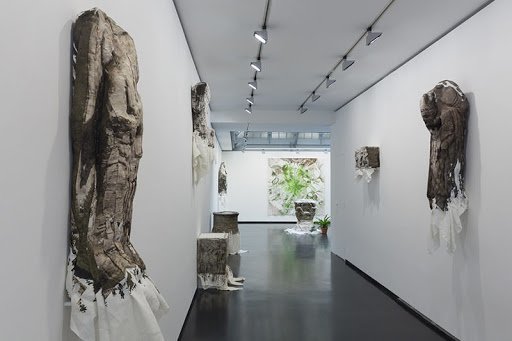 Surface Proxy ,Inkjet on belgian linen over CNC milled foam sculptures
2015, XPO Gallery, Paris France
Surface Proxy ,Inkjet on belgian linen over CNC milled foam sculptures
2015, XPO Gallery, Paris France
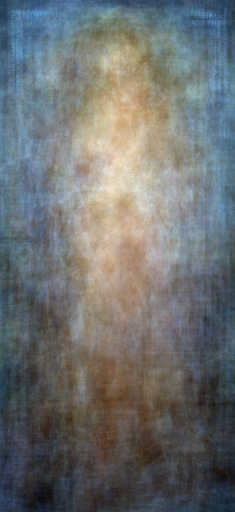 Jason Salavon Every Playboy Centerfold, The Decades